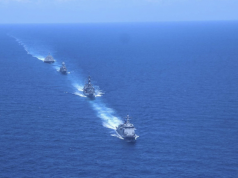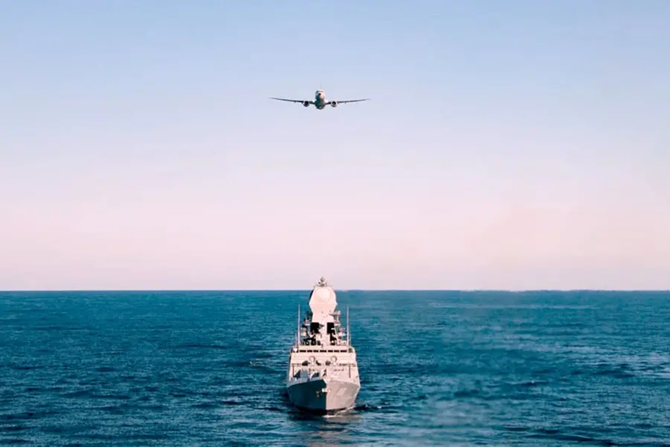
Así lo desgrana un artículo firmado por K. Raja Menon, quien se desempeñó como Subjefe de Estado Mayor de Operaciones en la Armada India. El especialista sostiene que la competición militar entre China e India “no va a ganarse en la frontera del Himalaya, donde la geografía es profundamente desfavorable a la India”, por lo que la mejor opción que tiene Nueva Delhi está en el Océano Índico.
En este sentido, refuerza el concepto de que la tecnología satelital ha resultado en que “todos los países se han vuelto expuestos y transparentes a una resolución de 10 centímetros”. En este contexto, cobra enorme relevancia la proliferación de sistemas de misiles mar-tierra, “que da a las Armadas la capacidad de ir más allá de atacar a flotas enemigas y atacar los países en sí”.
Siguiendo este argumento, Raja Menon sostiene que “la fuerza de las Armadas no se mide en el número de embarcaciones, sino en el número de Silos de lanzamiento verticales (VLS por sus siglas en inglés) que pueden incorporar”. Sus números muestran que la marina estadounidense actualmente cuenta con 9.900 de estas plataformas, mientras que la Armada china tiene 4.200.
Con este panorama, Raja Menon asegura que India debe aspirar a “no menos de 4.000 VLS para 2050”. Esto sería posible si su país continúa con la construcción de destructores Tipo 18 hasta llegar a un número de 30 embarcaciones, y también la construcción de al menos 24 submarinos de la generación SSN en el mismo plazo.
Por último, el especialista indio añade la necesidad de que India avance con la construcción de tres portaviones de “no menos de 80.000 toneladas, con lo que podría dominar el teatro de operaciones del océano indico hasta la troposfera”.
INDIA IS BUILDING ITS NAVAL STRATEGY WITH ITS SIGHTS SET ON CHINA
This is the argument presented in an article by K. Raja Menon, former Deputy Chief of Staff for Operations in the Indian Navy. The expert maintains that the military competition between China and India “will not be won on the Himalayan frontier, where the geography is profoundly unfavorable to India,” and therefore, New Delhi’s best option lies in the Indian Ocean.
In this regard, he reinforces the concept that satellite technology has resulted in “all countries becoming exposed and transparent at a resolution of 10 centimeters.” In this context, the proliferation of sea-to-surface missile systems takes on enormous relevance, “giving navies the capability to go beyond attacking enemy fleets and attack countries themselves.”
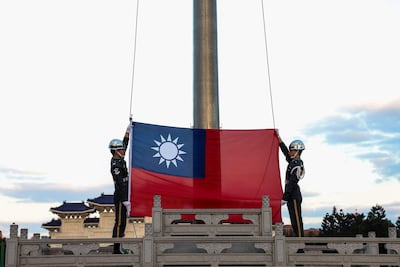 CÓMO TERMINA LA GUERA EN TAIWÁN. SI LA DISUASIÓN FALLA, ¿PODRÍA ESTADOS UNIDOS FRUSTRAR A CHINA?
En los últimos años, muchos en Washington se han centrado en disuadir a China de invadir Taiwán. Antes de asumir el cargo a principios de este año, Elbridge Colby, subsecretario de Defensa para Asuntos Políticos de Estados Unidos, afirmó que Taiwán debía concentrarse intensamente en implementar una defensa de negación contra la invasión. De hecho, una variedad de sistemas de armas pequeños y económicos resulta muy prometedora para repeler un desembarco anfibio chino. Por lo tanto, la nueva Estrategia de Defensa Nacional de la administración Trump acierta al adoptar una estrategia de negación para detener una invasión de Taiwán.
Pero rechazar una invasión podría no poner fin a la guerra. Joel Wuthnow, experto en el ejército chino, advirtió: «No existe ningún escenario en el que China, tras una invasión fallida, acepte la responsabilidad, reconozca que las soluciones militares son impracticables o cambie radicalmente sus objetivos políticos hacia Taiwán». Tras una invasión fallida, es poco probable que el líder chino Xi Jinping (o su sucesor) simplemente se rinda y regrese a casa. En cambio, los líderes chinos podrían razonar que tienen menos que perder si continúan la lucha.
HOW WAR IN TAIWAN ENDS. IF DETERRENCE FAILS, COULD AMERICA THWART CHINA?
In recent years, many in Washington have focused on deterring China from invading Taiwan. Before taking office earlier this year, Elbridge Colby, the U.S. undersecretary of defense for policy, asserted that Taiwan should be “laser focusing on implementing a denial defense against invasion.” Indeed, an array of small, inexpensive weapon systems holds great promise for repelling a Chinese amphibious landing. The Trump administration’s new National Defense Strategy is therefore correct to embrace a strategy of denial for stopping an invasion of Taiwan.
But rebuffing an invasion might not end the war. Joel Wuthnow, an expert on the Chinese military, has warned, “There is no scenario in which China, following an unsuccessful invasion, accepts responsibility, acknowledges that military solutions are impractical, or pivots to a fundamentally different set of political objectives toward Taiwan.” In the wake of a failed invasion, Chinese leader Xi Jinping (or his successor) would be unlikely to simply pack up and go home. Instead, Chinese leaders might reason that they have less to lose by continuing the fight.
This is why the political scientist Michael Beckley has argued that “war over Taiwan likely would become protracted, as nearly all great power wars have since the Industrial Revolution.” World War II ended only when Allied forces captured Germany’s capital and the United States dropped nuclear weapons on Japan. Neither option seems advisable in the context of a U.S.-Chinese war; Washington needs to find other ways to end it. And so, in the years to come, the United States must prepare two forces: one to stop a Chinese invasion and another to end the conflict. Preventing a war from starting in the first place will rely to some extent on the innovative forms of deterrence by denial on which the Trump administration and others have focused. But denial capabilities on their own will not be enough. Ending a war that churns on even after a failed invasion will also require old-fashioned power projection.
In denial
In the twentieth century, the United States perfected the art of projecting power around the globe. A combination of forward bases and aircraft carriers allowed U.S. forces to operate worldwide. With the fall of the Soviet Union in 1991, the U.S. military’s dominance also meant that one set of forces could employ two distinct forms of deterrence simultaneously: denial and punishment.
Consider the role of U.S. aircraft carrier strike groups during the 1996 Taiwan Strait crisis. At the time, China was staging military exercises and testing missiles in the waters around Taiwan. As tensions rose, Washington maneuvered two carriers near the island. Those strike groups practiced deterrence by denial by threatening to physically repel an attack. But they also performed deterrence through punishment by threatening severe consequences if Beijing went through with it, since carrier-based aircraft could strike ships heading toward China and even targets on the Chinese mainland.
In the last few years, however, the United States has begun tailoring its forces—and those of its allies and partners—for more specific missions. Forward bases and aircraft carriers are expensive to build and maintain, yet still vulnerable to ballistic missiles and other asymmetric systems. Pentagon officials are therefore pushing to acquire more “attritable” systems, which are relatively cheap to produce and designed to be expendable, for use by small units operating within the expanding area that China threatens. As David Berger, the former commandant of the U.S. Marine Corps, explained at a defense industry conference in 2021, the United States must “get comfortable with throwaway things.”
Ending a war over Taiwan will require old-fashioned power projection.
But attritable systems are of limited use against China’s day-to-day coercive operations in the air and sea around Taiwan. Last year, Taiwan detected 5,105 Chinese sorties into its airspace. Defending against these aircraft requires expensive jets rather than low-flying drones. In the maritime context, responding to Chinese naval incursions in the waters around Taiwan will require vessels that can monitor those activities and challenge Chinese forces if necessary.
Even after open conflict begins, denial is still only a partial answer. U.S. mines and missiles can sink Chinese vessels, killing thousands of troops in the process, but Chinese leaders might still seek at least a partial victory. The People’s Liberation Army could attempt to seize Taiwan’s outlying islands or conduct a maritime blockade while its military arsenal makes the waters around Taiwan a no man’s land. “There is no path to U.S. victory that does not include the long blockade,” the former intelligence officer Lonnie Henley has argued.
That is why the United States must be able to convince China that it will face unacceptable costs if it continues fighting in the wake of an unsuccessful invasion. A strategy of denial is only step one; the threat of punishment will be the United States’ ultimate trump card.
Can´t stop, won´t stop
The war in Ukraine illustrates the difficulty of terminating a conflict even after an initial invasion has bogged down. With small and cheap systems such as drones and mines, Ukraine was able to deny Russia a swift victory but has failed to impose costs high enough to convince Russian President Vladimir Putin to stop fighting. Russia has suffered terrible losses in the war, but Putin appears to have calculated that the costs of continuing are lower than the costs of admitting defeat.
Russia’s example serves as a warning about China’s likely behavior. Ideally, the prospect of a failed invasion of Taiwan would deter China, but Chinese leaders might perceive several incentives for protracting a war following an initial loss. First, China’s industrial capacity far outstrips that of the United States, so it could recapitalize its forces more rapidly. Over the last three decades, China has undergone a massive military buildup. The Office of Naval Intelligence has assessed that China has over 230 times the shipbuilding capacity of the United States. Meanwhile, U.S. armed forces face significant munitions shortages, with some experts predicting that American stockpiles would be expended after just weeks, or even days, of a conflict with China.
Beijing might believe it can outlast Washington and Taipei in terms of other supplies, as well. Getting provisions across land into Ukraine has proved challenging; delivering even basic necessities over water to Taiwan amid a conflict with China would be an order of magnitude more difficult. Taiwan is a relatively small island with limited food and energy stockpiles. Conversely, Beijing’s rapid expansion of wind, solar, and nuclear power would help insulate it against a U.S. energy blockade.
Beijing believes it could win a contest of wills over Taiwan.
A conflict over Taiwan could eventually become a contest of wills—which Beijing believes it could win. Chinese officials have described Taiwan as “the very core of China’s core interests.” U.S. President Donald Trump’s take is decidedly different: “Taiwan is 9,500 miles away,” he said in an interview with Bloomberg Businessweek. “It’s 68 miles away from China. I just think we have to be smart . . . it’s a very, very difficult thing.” The American people support Taiwan, but many do not want a direct conflict with China: when asked in 2024 by the Chicago Council on Global Affairs about their commitment to defending Taiwan from a Chinese invasion, the majority of Americans surveyed either opposed such a policy or were unsure.
A Chinese failure in a conflict over Taiwan could also threaten Xi or his successor’s hold on power and undermine the legitimacy of the Chinese Communist Party. Xi would want to avoid an admission of failure and thus might order the Chinese military to keep waging an unsuccessful war. Without the prospect of punishment, the CCP might decide that failure poses a greater risk than continuing the conflict.
For all these reasons, Chinese leaders might prefer to keep fighting even after an initial defeat. To bring the conflict to a close, the United States would need to credibly threaten punishment. Colby and other Trump administration officials clearly recognize this; he co-authored a 2022 report advocating “selective punishment operations” and “cost-imposition to favorably manage escalation and seek to terminate a war with China.” These operations could include an embargo or the seizure of Chinese assets held abroad. But Beijing has been insulating itself against political and economic pressure, so military escalation might well be required, including strikes on critical infrastructure and parts of China’s defense-industrial base. These moves would raise the costs for China of continuing a conflict, but they also present a strategic dilemma.
The goldilocks paradox
A number of factors would complicate any threat of punishment. First is what researchers at the RAND Corporation have termed the “Goldilocks challenge”: threats of punishment must be high enough to persuade Beijing to end a conflict in which it is deeply invested but low enough to avoid provoking unacceptable escalation, such as nuclear use. Finding this middle ground would not be an easy task.
It will therefore be important to try to keep an initial fight over Taiwan limited in order to provide Chinese leaders a pathway for deescalation. Chinese leaders might back down after claiming to have taught Taiwan a lesson or taken some contested territory. Yet China’s own messaging before a conflict could set a higher bar: Chinese leaders might demonize Taiwan and the United States to rally public support, while trumpeting the PLA’s military superiority and China’s great rejuvenation. An invasion of Taiwan might start with Beijing metaphorically burning its ships so there would be no turning back.
In the aftermath of a conflict in the Taiwan Strait, politicians in Washington, Taipei, and elsewhere might themselves raise the stakes. They could seek to use Beijing’s moment of weakness to constrain China’s ambitions, formalize Taiwan’s independence, or undermine the CCP’s hold on power. There would be a fine line between “too hot” and “too cold” policies, and the tradeoffs would become more difficult as the war grew longer, bloodier, and more destructive.
A second challenge is that U.S. “horizontal escalation”—widening the scope of the conflict—may not be as effective today as it once might have been. Devoting more funding to denial capabilities risks cannibalizing resources for military platforms more capable of threatening punishment, such as stealthy bombers and submarines armed with cruise missiles. And although American strategists have discussed the possibility of a blockade to prevent China from importing energy supplies, the country’s nuclear power plants and renewable energy sources now account for a third of its energy production, so that Beijing is less vulnerable to an energy blockade. Cutting China’s fossil fuel imports would hurt over time, but Taiwan would be in a far more dire position.
Therefore, the biggest challenge for the Trump administration’s National Defense Strategy is not whether it allocates resources to a strategy of denial but how it integrates denial and punishment into a holistic deterrence framework. Rebuffing an initial attack on Taiwan is necessary but not sufficient. Without a plan for terminating a war, Washington would risk repeating the pattern of U.S. strategy in Iraq and Afghanistan that many Trump officials critiqued: winning the first battle but losing the war. If the United States is to deter China, it will have to persuade Chinese leaders that Washington has a strategy not only for the early stages of a conflict but also for the end stage of a war.
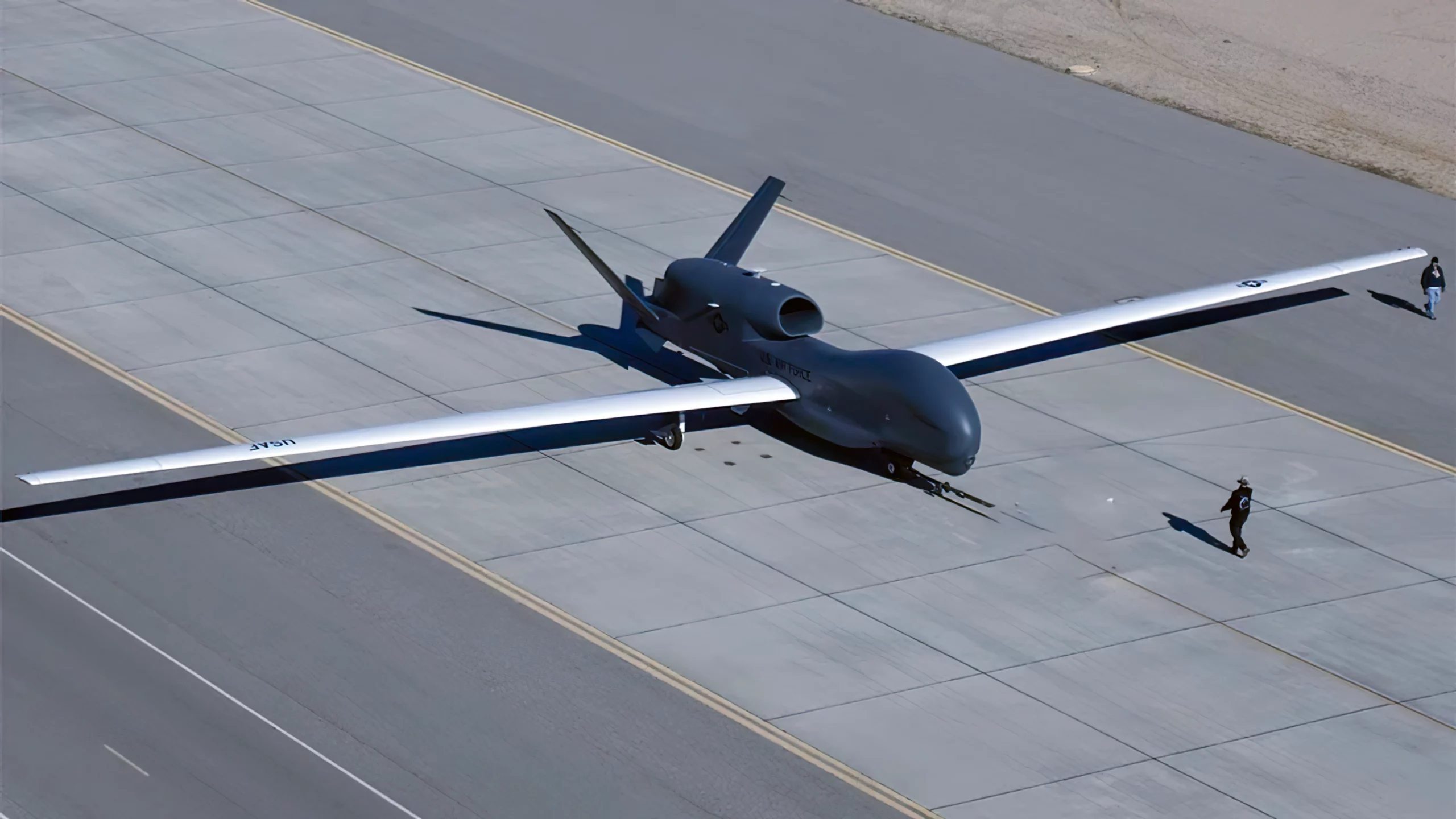 EL FUTURO DE LA COOPERACIÓN ENTRE TAIWÁN Y EE. UU. EN MATERIA DE DRONES
La mayor exposición de defensa de Taiwán puso de manifiesto la colaboración sin precedentes entre ambos países en materia de drones, pero las políticas de Trump generan incertidumbre.
Dado que los sistemas aéreos no tripulados (UAS) se han vuelto cruciales para la guerra moderna, la cooperación entre Taiwán y EE. UU. en la creación de una cadena de suministro conjunta ha logrado avances notables mediante la venta de UAS estadounidenses, alianzas para subsistemas y el establecimiento de contactos comerciales. Estos avances se presentaron en la Exposición de Tecnología Aeroespacial y de Defensa de Taipéi, celebrada en septiembre, que reunió a 400 empresas de 15 países, la mayoría del sector de sistemas no tripulados. Durante el evento, el Instituto Nacional de Ciencia y Tecnología Chung-Shan (NCSIST), un instituto gubernamental taiwanés, anunció su primera colaboración con varias empresas estadounidenses, entre las que se incluyen la coproducción de munición merodeadora con Anduril, el UAV de ataque de alta velocidad Mighty Hornet IV con Kratos y la serie de UAV JUMP 20 con AeroVironment.
Fuente: https://thediplomat.com/2025/10/the-future-of-taiwan-us-drone-cooperation/
THE FUTURE OF TAIWAN-US DRONE COOPERATION
Taiwan’s largest Defense Expo showcased the record drone collaborations between the two countries, but Trump’s policies are adding uncertainty.
With uncrewed aircraft systems (UAS) becoming critical to modern warfare, Taiwan-U.S. cooperation on building a joint supply chain has made notable progress through U.S. UAS sales, subsystem partnerships, and business matchmaking. The progress was showcased in the Taipei Aerospace & Defense Technology Exhibition in September, which brought together 400 companies from 15 countries, most in the uncrewed system sector. During the event, the National Chung-Shan Institute of Science and Technology (NCSIST), a Taiwanese government-affiliated institute, announced its first cooperation with several American companies, including the co-production of loitering munition with Anduril, the Mighty Hornet IV high-speed attack UAV with Kratos, and the JUMP 20 series of UAVs with AeroVironment.
Simultaneously, Taiwanese UAS exports to the United States have reached a peak. According to official data, Taiwan exported 5,017 UAS to the U.S. in 2025 up to July, which is almost six times the number exported in the whole 2024. What’s more, Taiwanese UAS company Thunder Tiger recently announced that its UAS was added to the U.S. Department of Defense’s Blue UAS Cleared List, making it the very first Taiwan company on the list.
Despite the rapid progress, Taiwan is still struggling to achieve its goal of self-reliant UAS production. While Ukraine produces 4 million UAS annually, the Taiwanese Ministry of National Defense set a much smaller goal of 50,000 UAS before 2027. Because Taiwan prohibits the use of low-cost Chinese components, production costs are higher, making it difficult to compete in international markets and limiting overall capacity growth. Taiwan’s limited production capacity, the early stage of joint R&D, and the absence of Taiwanese UAS in U.S. supply chains still hinder cooperation.
Recent Trump administration and Department of Defense (DoD) policies advancing allied cooperation while prioritizing “America First” manufacturing create both opportunities and challenges, while U.S. congressional initiatives point to deeper cooperation – provided they are institutionalized within a lasting framework.
A Progressing Taiwan-U.S. UAS Alliance With Limits
The recent expansion of Taiwan-U.S. cooperation is substantial, ranging from exports to procurement and technological collaboration. According to the Research Institute for Democracy, Society, and Emerging Technology (DSET), which utilizes official export data, Taiwan’s exports to the U.S. rose from just 278 units in 2023 to 874 units in 2024, and then surged to 5,017 units in 2025. By the second quarter of 2025, the United States had become one of Taiwan’s top three export destinations for UAS, after Poland and Czechia.
Until September 2025, no Taiwanese company had been included on DoD’s Blue UAS list or secured U.S. federal procurement contracts; sales were limited to state and local government agencies for policing and public security. That changed when Thunder Tiger became the first Taiwanese firm added to the Blue List, paving the way for potential federal purchases.
On the technology collaboration side, according to DSET’s research, progress in joint production remained limited before mid-2025. Taiwan had continued to acquire advanced systems through Foreign Military Sales, but its role had largely been confined to adaptation and sustainment. Unlike Japan or South Korea, Taiwan lacks a framework for co-production, assembly, or joint development with the United States. This began to shift, with the inclusion of provisions in the draft of the Fiscal Year 2026 National Defense Authorization Act (NDAA) that explicitly supported Taiwan-U.S. co-production. Senator Roger Wicker’s August visit to Taipei further signaled this policy direction. Last month, Taiwan announced multiple joint co-development and co-production initiatives with U.S. companies.
At the business-to-business level, Taiwanese companies are also working directly with U.S. partners. Thunder Tiger has partnered with Auterion on the Overkill loitering munition, while Aerospace Industrial Development Corporation (AIDC) is collaborating with Maxar Intelligence to enhance UAV positioning and mapping.
Vice President Chien Ting-hua of NCSIST stated that after Anduril’s on-site assessment, the company concluded that “establishing a low-cost, domestically based autonomous loitering-munition supply chain in Taiwan would take only 18 months.” The system is Anduril’s Barracuda, a Group 3 loitering munition, underscoring Taiwan’s potential in higher-end UAS production.
AIDC, which leads the Taiwan Excellence Drone International Business Opportunities Alliance, is pursuing certification by linking directly with U.S. bodies and building a domestic mechanism. Acting Chairman Tsao Chin-ping stressed that with “non-red supply chain” compliance checks, “Taiwanese companies will become qualified suppliers for the U.S., opening up unlimited possibilities.”
Yet, to meet Taiwan’s production goals for UAS, the current pace of progress must be accelerated. While recent U.S. policy signals create opportunities, they also pose challenges. Trump’s Executive Order 14307 in June, followed by a DoD implementation memo and a Department of Commerce’s Section 232 investigation into UAS imports, aims not only to exclude Chinese components from UAS supply chains but also to place greater emphasis on “America First” procurement. For Taiwan-U.S. UAS cooperation to deepen, both governments and industry must navigate the uncertainties these new policies bring.
New “America First” UAS Policy and Allied Cooperation
During the Biden administration, U.S. policy emphasized restricting adversarial UAS suppliers from U.S. procurement while gradually promoting allied cooperation in production. The Trump administration shifted priority to expanding domestic UAS capacity, though allied cooperation advanced in parallel. For foreign suppliers, the mixed signals in policy bring both new opportunities and new challenges.
The restrictive trend began in 2019, during Trump’s first term, with the FY2020 NDAA, Section 848, which prohibited DoD procurement of UAS and components manufactured in China. The Biden administration reinforced the effort next year with 2021 DoD guidance clarifying definitions of critical components and procurement standards. Further restrictions expanded through subsequent legislation: Section 817 of the FY2023 NDAA added Russia, Iran, and North Korea to the list of prohibited supplier countries and extended regulation coverage from DoD to contracted services. The 2023 American Security Drone Act broadened the ban to all federal agencies, creating a comprehensive barrier against adversarial suppliers.
As the embodiment of this series of restrictive policies, the Blue UAS List, a cleared procurement list managed by the Defense Innovation Unit (DIU), was established in 2020 and evolved into a mechanism for excluding adversarial suppliers.
Trump’s return to office introduced a stronger “America First” acquisition strategy. His executive order 14307 explicitly prioritized U.S.-manufactured UAS over foreign-made systems, aiming to build a strong and secure domestic UAS sector. The order also called for accelerating UAS integration into the National Airspace System, advancing domestic commercialization through industry-led innovation and regulatory streamlining, and strengthening the domestic industrial base while promoting exports.
Following the order, the DoD issued an implementation memorandum outlining key changes. Biden-era guidelines deemed burdensome were rescinded. The Blue UAS List was restructured by expanding certification authority to frontline units and other empowered agencies, accelerating approval timelines, and transferring its management to the Defense Contract Management Agency, which has greater administrative capacity. To expand small UAS (sUAS) adoption, rules were introduced to improve interoperability, speed delivery, and enhance flexibility. sUAS were reclassified as consumables to encourage rapid adoption, while limited adversarial procurement remained permissible for narrowly defined missions.
In parallel, the Commerce Department initiated a Section 232 investigation into UAS and component imports, assessing national security risks that could lead to tariffs or other trade measures targeting foreign suppliers.
Despite Trump’s domestic focus, allied cooperation developed late in the Biden administration has not been sidelined. Under Biden, Section 162 in the FY2025 NDAA directed the DoD to strengthen sUAS supply-chain resilience by leveraging domestic, allied, and partner sources. Complementing this, the DoD launched Partnership for Indo-Pacific Industrial Resilience (PIPIR) in 2024 to strengthen industrial resilience, expand capacity, and accelerate deliveries. The initiative includes 14 partner nations in the region, including Taiwan.
The Trump administration has carried allied cooperation forward. Soon after his inauguration, the DIU announced a significant update to the Blue UAS List, adding allied suppliers such as companies from Switzerland, France, and Norway. At the 2025 Shangri-La Dialogue, Secretary of Defense Pete Hegseth highlighted PIPIR as a key pillar of regional deterrence, announcing UAS industrial collaboration as one of its first projects. Later in the year, the DIU confirmed to reporters its plans to open an office in Taiwan, noting that UAS will certainly be a focus. The move signals continuity in allied cooperation under the Trump administration.
Meanwhile, congressional support continues. Section 1237 of Senate Armed Services Committee’s markup of the FY2026 NDAA calls for the establishment of a joint program for the fielding, co-development, and co-production of uncrewed and counter-uncrewed systems with Taiwan, with annual reporting through 2029. As a continuation of this policy, the DIU is reported to be expanding allied procurement channels to deepen regional collaboration on UAS.
Next Steps: The Critical Moment for Deterring China
These developments bring both opportunities and challenges for Taiwan. On the positive side, the order directs expansion and more frequent updates of the Blue UAS list, clarifying the pathway for Taiwan to secure access. However, the same order prioritizes U.S.-made systems, raising the bar for foreign suppliers.U.S. legislative momentum could change this. Section 1237 of the Senate’s FY2026 NDAA markup calls for a joint Taiwan-U.S. program to field, co-develop, and co-produce uncrewed and counter-uncrewed systems. The U.S.-Taiwan Defense Innovation Partnership Act of 2025, introduced in the House by members of the Select Committee on the CCP, proposes a structured partnership to coordinate development of dual-use capabilities, including UAS.
Neither measure has been enacted, but both signal plausible next steps. If advanced, they would create a pathway for Taiwan to move beyond adaptation and sustainment and take initial steps toward a role in the production cycle, including greater ability to support and maintain systems in a conflict.
In practice, this shift would serve two goals: first, improving Taiwan’s ability to field and sustain key platforms under crisis; and second, reducing long-term sustainment burdens on the U.S. by pre-positioning production capacity inside the theater. Anchoring co-production in platforms already in Taiwan’s inventory would speed integration and strengthen deterrence.
Three strategic messages stand out. First, Taiwan’s entry into U.S. government procurement through Blue UAS certification is the necessary starting point to serve strategic goals for both Taiwan and the U.S. Achieving this requires a non-red supply chain that can meet U.S. certification and regulatory standards.
Second, moving beyond adaptation and sustainment will require co-production. The most feasible opportunities are in sUAS systems such as loitering munitions, where joint production would build lifecycle capacity and enable Taiwan to sustain platforms in conflict without relying entirely on external support.
Third, legislative measures now under discussion in Washington, including Section 1237 of the Senate’s FY2026 NDAA markup and the proposed U.S.-Taiwan Defense Innovation Partnership Act, could provide initial frameworks for joint programs. Taken together, these steps will determine whether Taiwan’s UAS strengthen deterrence in the Indo-Pacific and share the sustainment burden with the United States, or remain limited to domestic use.
Published twice per week by Nuevo Poder. Articles and op-eds focusing on geopolitical issues around Indo-Pacific area
Editor: LW, senior fellow of REDCAEM and CESCOS
Submit contributions (that can be read with ease and pleasure), to ilwb@email.cz