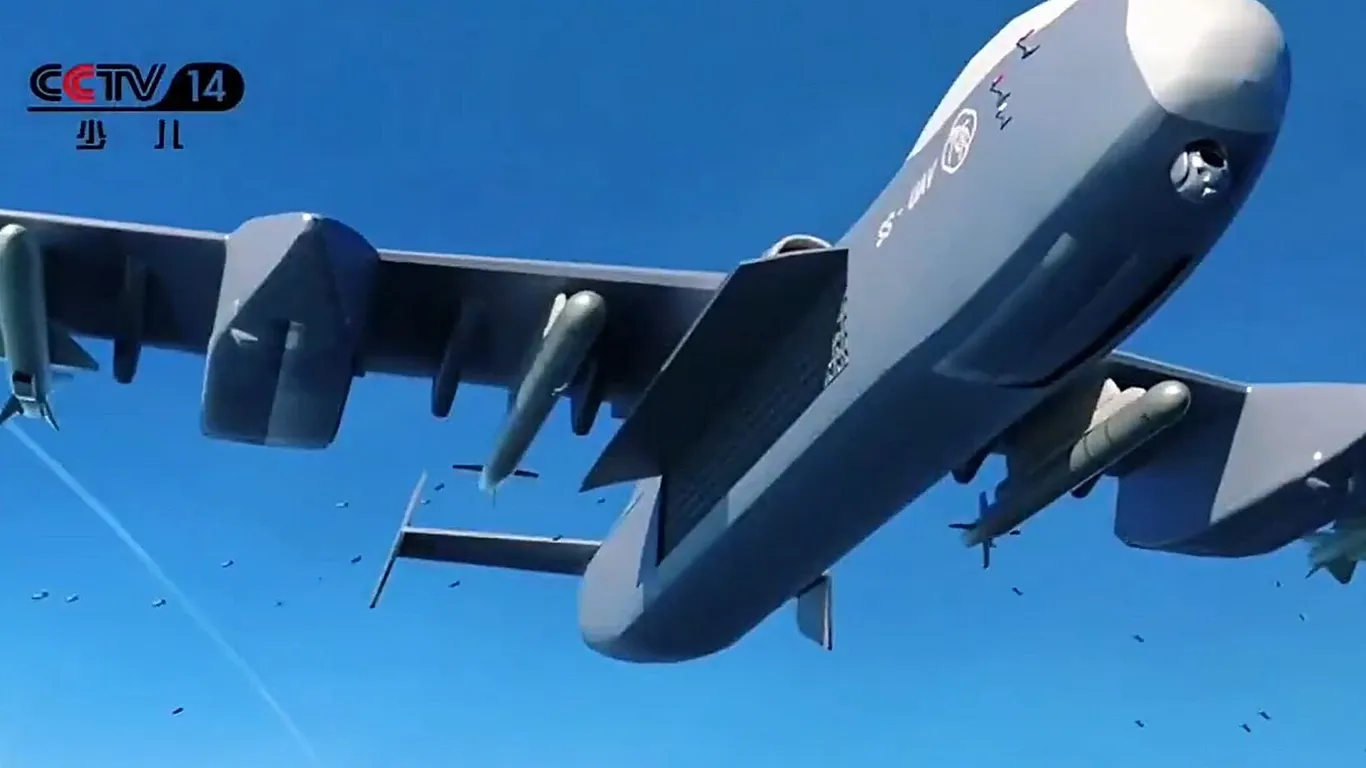
En breve empezarán las pruebas de vuelo de un nuevo dron aéreo nodriza, el Jiu Tian o ‘Cielo alto’, que fue presentado previamente en el Salón Aeronáutico de Zhuhai. Una vez esté plenamente operativo podrá lanzar desde ambos lados de su panza un enjambre de hasta 100 drones más pequeños o vehículos aéreos no tripulados kamikazes que actuarán como una legión de defensa antiaérea para desbordar al enemigo. El Ejército Popular de Liberación (EPL) será el encargado de desplegarlo y llevar a un nuevo nivel el combate aéreo. El medio especializado ‘Galaxia Militar’ describe que geopolíticamente, esta nave señala la intención de China de invertir en multiplicadores de fuerza asimétricos y escalables, desafiando los paradigmas tradicionales del poder aéreo occidental.
Al mismo tiempo, señala una fase crucial en la ambición de China de liderar las operaciones de comando y control con drones, y la proyección asimétrica frente a Taiwán y los vecinos del mar de la China Meridional. Está concebido no solo como una plataforma de sensores o un bombardero, sino como un nodo de mando aéreo que orquesta complejas operaciones de enjambre a grandes distancias.
Es un dron de ataque de gran altitud de quinta generación diseñado por el gigante aeroespacial estatal Aviation Industry Corporation of China. El Jiu Tian tiene un alcance de hasta 7.000 kilómetros, una envergadura de 25 metros y puede transportar 6 toneladas de munición, además de los minidrones. El dron propulsado por chorro tiene un peso máximo de despegue de 16 toneladas. Y como detalla ‘South Morning China Post’ tiene la capacidad de volar por encima de muchos de los sistemas de defensa de mediano alcance que están desplegados en todo el mundo. Y puede realizar misiones de inteligencia, vigilancia y reconocimiento, así como guerra electrónica.
Este avión no tripulado de largo alcance tendrá que pasar una serie de pruebas antes de su uso por las Fuerzas Aéreas chinas. Y puede paralizar infraestructuras en cuestión de minutos gracias a las colmenas de drones que puede trasladar. Además, según SCMP, el Jiu Tian será rival de modelos estadounidenses como el RQ-4 Global Hawk que puede realizar reconocimiento avanzado a una altitud de hasta 18.000 metros y tiene un peso máximo de despegue similar al del Jiu Tian, pero no puede realizar ataques. Y también será un competidor frente al MQ-9 Reaper es un vehículo aéreo no tripulado (UAV) multifunción de altitud media con un peso máximo de despegue de unas 5 toneladas.
CHINA TO DEPLOY WORLD’S LARGEST FLYING AIRCRAFT CARRIER READY TO LAUNCH 100 DRONES FOR MASSIVE ATTACKS
Flight testing of a new aerial mothership drone, the Jiu Tian or «High Sky,» which was previously unveiled at the Zhuhai Air Show, will soon begin. Once fully operational, it will be able to launch a swarm of up to 100 smaller drones or kamikaze unmanned aerial vehicles from both sides of its belly, acting as a legion of anti-aircraft defenses to overwhelm the enemy. The People’s Liberation Army (PLA) will be responsible for deploying it and taking aerial combat to a new level. The specialized media outlet «Military Galaxy» describes that geopolitically, this ship signals China’s intention to invest in asymmetric and scalable force multipliers, challenging traditional paradigms of Western air power.
At the same time, it marks a crucial phase in China’s ambition to lead drone command and control operations and asymmetric projection against Taiwan and its South China Sea neighbors. It is conceived not simply as a sensor platform or bomber, but as an airborne command node orchestrating complex swarm operations over long distances.
 EL INDO-PACÍFICO SE HA CONVERTIDO EN UN ESCENARIO DE RIVALIDAD ENTRE GRANDES POTENCIAS Y UN CAMPO DE PRUEBAS PARA LA EVOLUCIÓN DE LA RELACIÓN ENTRE CHINA Y RUSIA
- Resumen Ejecutivo
- Introducción
- Agencia Regional en la Práctica
- Caso Práctico: India
- Caso Práctico: Indonesia
- Caso Práctico: Estados del Litoral del Mar de China Meridional
- Implicaciones de la Agencia Regional
- Conclusión
Resumen Ejecutivo
- Los actores regionales ya están configurando su entorno estratégico mediante comportamientos que limitan la coherencia de las iniciativas chino-rusas mediante la evasión de riesgos, la señalización legal, la recalibración de alianzas y la interacción selectiva.
- La postura multisocio de la India y la diversificación de la defensa introducen fricción en la coherencia diplomática y militar de la alianza Moscú-Pekín.
- Indonesia utiliza una ambigüedad calibrada para evitar enredos y mantener alianzas diversificadas, lo que dificulta la coordinación entre China y Rusia. Los estados ribereños del Mar de China Meridional, en particular Vietnam y Filipinas, afirman su soberanía mediante medios legales, militares e informativos. Sus acciones obstaculizan la comunicación externa e introducen asimetrías que debilitan las posiciones coordinadas.
La interacción política debería reforzar las fricciones existentes en lugar de intentar sustituirlas. El apoyo a la capacidad jurídica, la autonomía regulatoria, la resiliencia digital y la diversificación de la defensa contribuye a fortalecer la capacidad de acción regional y a mantener un equilibrio multipolar.
Fuente: https://cepa.org/comprehensive-reports/strategic-friction-indo-pacific-curbs-on-china-and-russia/
THE INDO-PACIFIC HAS BECOME A THEATER OF GREAT POWER RIVALRY AND TESTING GROUND FOR THE ENVOLVING RELATIONSHIP BETWEEN CHINA AND RUSSIA
- Executive Summary
- Introduction
- Regional Agency in Practice
- Case Study: India
- Case Study: Indonesia
- Case Study: South China Sea Littoral States
- Implications of Regional Agency
- Conclusion
Executive Summary
- Regional actors are already shaping their strategic environment through behavior that limits the coherence of Sino-Russian initiatives through hedging, legal signaling, alliance recalibration, and selective engagement.
- India’s multi-partner posture and defense diversification injects friction into the diplomatic and military coherence of the Moscow-Beijing partnership.
- Indonesia uses calibrated ambiguity to avoid entanglement and maintain diversified partnerships, complicating coordination between China and Russia.
- The South China Sea littoral states, specifically Vietnam and the Philippines, assert sovereignty through legal, military, and informational means. Their actions impede external signaling and introduce asymmetries that undercut coordinated positions.
- Policy engagement should reinforce existing friction rather than seeking to replace it. Support for legal capacity, regulatory autonomy, digital resilience, and defense diversification helps strengthen regional agency and sustain a multipolar equilibrium.
Introduction
As geopolitical gravity shifts towards Asia, the Indo-Pacific has become a theater of great power rivalry and a testing ground for new alignments. Among the more visible developments is the evolving relationship between China and Russia, often described as a “no-limits” partnership since Russia’s 2022 full-scale invasion of Ukraine. This framing, however, risks overstating the depth and coherence of what remains an uneven, interest-based relationship. What appears as convergence from a distance is often fragmented in practice, shaped less by coherent partnership than by the actions of Indo-Pacific countries.
This study examines how countries in the Indo-Pacific affect, rather than merely absorb, Sino-Russian cooperation. In contrast to analyses that focus primarily on Beijing and Moscow’s partnership, this paper shifts the analytical lens to other countries in the region and argues that they condition what China and Russia can achieve. Focusing on three case studies — India, Indonesia, and the South China Sea — and using a matrix-based framework, it examines how regional actors influence the region’s dynamics. It is nevertheles worth noting that China and Russia are not static actors. Beijing and Moscow adapt their posture to regional behaviours and constraints as needs demand. In some cases, they respond with flexibility as evidenced by Russia’s relationship with India or China’s calibrated investment posture in Southeast Asia. At other times, their reactions expose divergent interests, methods, or even tolerance for friction with regional actors. These reactions, while not the focus of this paper, provide useful insight into the fluid and contested nature of their engagement in and with the Indo-Pacific.
Analytical Framework
To understand how regional action shapes great power behavior, this section introduces a two-part framework. The first presents a typology of coordination between China and Russia, distinguishing between forms of cooperation that are strategic and sustained, and those that are symbolic, coincidental or contested. The second component overlays the matrix with a framework to understand how regional states assert influence across four domains: Diplomatic, Informational, Military, and Economic (DIME).
The goal of this approach is to show that the variability in Sino-Russian coordination across the Indo-Pacific is not driven solely by decisions in Beijing or Moscow. While China, given its strategic interest in the Indo-Pacific, often plays the more assertive regional role, Russia’s posture reflects a growing need to diversify its partnerships, which don’t always align with Chinese objectives. These internal differences, when filtered through regional dynamics, help explain why coordination remains selective and uneven.
Regional Agency in Practice
The following case studies demonstrate distinct expressions of regional agency across geopolitical, institutional, and societal contexts. Each shows how local actors shape, filter, or fragment Sino-Russian coordination, not by reacting passively, but by asserting preferences that calibrate the terms of external engagement.
Case Study: India
India is a pivotal actor in the Indo-Pacific: geopolitically assertive, strategically autonomous, and increasingly central to the region’s evolving balance of power. Long defined by its principle of non-alignment, rearticulated through its doctrine of strategic autonomy, India has resisted binary choices between great powers, instead cultivating a foreign policy that hedges alignments without locking into any one camp.1
Drivers of India’s Strategic Posture
India’s posture in the Indo-Pacific is shaped by a complex interplay of historical legacies, domestic imperatives, and evolving threat perceptions. These drivers shape how India engages with external powers, including Beijing and Moscow, and lay the groundwork for understanding how New Delhi advances its interests.
At the core of India’s foreign policy is the principle of strategic autonomy, a long-standing tenet that has evolved from non-alignment into a posture of multi-alignment.2 This doctrine, broadly supported across the political spectrum, reflects skepticism about exclusive formal alliances and aims to safeguard India’s ability to independently calibrate its external partnerships. It has allowed New Delhi to adopt a multi-vector foreign policy which permits deep engagement with the US, Japan, and Australia, for example, through the Quad, while maintaining regular bilateral ties with both Russia and China.3
In the military domain, India’s posture reflects this balancing logic. Despite longstanding defense ties with Russia, particularly around fighter aircraft, submarines, and missile systems, India has worked to diversify its procurement to include France, the US, and Israel.4 At the same time, New Delhi has pursued indigenous capability, under the “Atmanirbhar Bharat” (self-reliant India) agenda, and expanded participation in joint exercises with a diverse set of partners. These efforts reflect a deliberate rejection of dependency.5
Economically, India’s ambition for high growth to meet the needs of its burgeoning population is balanced against national security concerns, particularly in relation to China. While bilateral trade with Beijing remains substantial, New Delhi has attempted selective decoupling in sensitive sectors such as telecommunications, digital infrastructure, and critical technologies.2 Industrial policies, including “Make in India” and production-linked incentives, aim to secure economic sovereignty while staying integrated in global supply chains.4
Informationally and diplomatically, the picture is similarly complex. China remains a subject of strategic concern in Indian public discourse, especially given the intermittent border skirmishes in Ladakh.6 At the same time, New Delhi’s relationship with Washington (and the broader West) is cautious but increasingly positive. External Affairs Minister Subrahmanyam Jaishankar’s articulation of India as “non-West but not anti-West” captures this orientation.7
Taken together, India’s DIME posture reflects a deliberate strategy of emphasizing diversification over dependence, flexibility over bloc politics, and issue-based engagement over rigid alignment. This approach preserves India’s ability to navigate an increasingly multipolar region while influencing the behavior of the major powers operating within it.
India’s Influence on Sino-Russian Cooperation in the Indo-Pacific
India does not directly confront or contest the China-Russia strategic partnership, yet its posture functions as a structural constraint on the depth and durability of Sino-Russian cooperation across all four coordination areas.
In terms of strategic alignment, India’s defense and diplomatic engagement with Russia is consistently decoupled from support for China, due to New Delhi’s security concerns about Beijing’s regional agenda.8 While India conducts military exercises with Russia, it avoids trilateral formats that would imply alignment with China. Its participation in Russia’s Vostok 2022 exercises, for example, was carefully limited and avoided the maritime component near the disputed Kuril Islands in a move seen as a gesture to Japanese sensitivities.9 Diplomatically, India has also resisted bloc-like signaling, notably working to soften language in G20 communiqués, for example during the 2022 Bali Summit in Indonesia.10 Russia, for its part, remains neutral on issues such as the Sino-Indian border, reflecting a desire to preserve both relationships.
Parallel actions by the three powers are also evident, and while they all express an inclination for rebalancing global power, their rhetoric and methods differ. New Delhi’s pursuit of coalition-building and multilateral diplomacy contrasts with the more coercive methods favored by Beijing, such as its assertive posturing in the South China Sea, and Moscow’s defense export diplomacy.11 Even when their objectives partially overlap, such as challenging Western dominance, India’s hedging introduces friction by limiting opportunities for consolidated messaging or joint initiatives. Its non-participation in joint strategic formats with China and Russia leaves both working around, rather than through, New Delhi.
In the sphere of symbolic coordination, India remains a participant in forums like BRICS+ and the Shanghai Cooperation Organisation (SCO), but its engagement often seems calibrated to preserve flexibility rather than signal alignment. As recent analyses of BRICS+ expansion have noted, India consistently pushes back against Chinese efforts to position the group as an explicit counterweight to Western institutions, preferring to emphasize the reform of existing multilateral structures rather than the creation of parallel ones.12 This posture reflects a strategic choice to maintain normative ambiguity, complicating efforts by Beijing and Moscow to present a unified alternative order.
Competitive divergence emerges most clearly in India’s work toward defense diversification and digital sovereignty. Its expanding defense ties with the US, France, and Israel reduce Russia’s market dominance, while its rejection of Chinese-led infrastructure initiatives, and participation in the Indo-Pacific Economic Framework (IPEF), frustrate Beijing’s regional footprint.13 New Delhi’s nuanced economic posture is also shaping the normative perimeter of the region’s digital infrastructure. Its introduction of frameworks like the Digital Personal Data Protection Act — inspired in part by the EU’s General Data Protection Regulation — signals a tilt toward transparency and rule-of-law, subtly diverging from the more state-centric data governance models associated with China and Russia.
India’s influence, therefore, lies not in direct opposition, but in conditioning the space in which deepening Sino-Russian convergence might otherwise occur. By asserting its own preferences and retaining the freedom to hedge, India injects friction into the relationship through its assertion of sovereignty and self-interest. The friction lies not in India’s outright rejection but in its non-conformity, it is the “third variable” that neither Russia nor China can fully incorporate into their own partnership yet they cannot afford to ignore.
Case Study: Indonesia
Indonesia is often described as a strategic “swing state” in the Indo-Pacific: pragmatic, hedging, and deeply attuned to its own national interest. It is also the largest Association of Southeast Asian Nations (ASEAN) member, a G20 economy, and the only Southeast Asian state to be a member of the BRICS+ group, lending it notable weight in regional diplomacy. Jakarta’s Indo-Pacific posture reflects a country still consolidating its role as a strategic actor: increasingly confident in voice, but cautious in stretching its autonomy too far. It is not a peer competitor to China or Russia but is a consequential moderator making choices that introduce ambiguity and impose friction, often subtly rather than through direct opposition.
Drivers of Indonesia’s Strategic Posture
At the heart of Indonesia’s foreign policy is the principle of “bebas dan aktif” (free and active), which underpins its preference for strategic independence and multilateral engagement without alignment.14 This orientation has allowed Jakarta to engage with a wide range of partners while avoiding entanglement in great power rivalries. Under President Prabowo Subianto, who was elected in 2024, its approach has acquired a more assertive tone, but not a fundamentally new direction.
Diplomatically, Jakarta champions ASEAN centrality, though inconsistently, and avoids language that might imply alignment with either great power.15 It maintains regular engagement with China and Russia while also engaging with Western partners, and its approach is marked by quiet diplomacy and a preference for inclusive over exclusive formats. At times, Jakarta bypasses ASEAN mechanisms in favor of more pragmatic or nationally beneficial arrangements, revealing a tension between its regional leadership ambitions and its individual sovereignty. The country’s island identity also informs its maritime priorities and concern over violations of international law, particularly in the South China Sea.16
Economically, Indonesia is an emergent power with ambitious development targets. Prabowo’s flagship programs, including the Free Nutritious Meal initiative and the $900bn Danantara sovereign wealth fund, signal a shift toward state-led growth.17 China remains a vital partner, particularly through the Belt and Road Initiative (BRI),18 which has funded dozens of infrastructure projects,[25] yet Indonesia has also tightened oversight of BRI-linked investments, seeking greater regulatory transparency and localization.19 It has diversified its economic partnerships, including with Japan, the US and Europe, and participates in the Indo-Pacific Economic Framework (IPEF). Russia’s footprint in Indonesia is limited and concentrated in energy and arms, but Jakarta still engages with Moscow, albeit cautiously, as part of its broader diversification strategy.
This restraint is visible in the military domain. In early 2025, Indonesia reportedly rejected a Russian request to establish a base for long-range aircraft in Papua, reaffirming Jakarta’s preference for regional balance.20 Indonesia’s modernization ambitions remain selective and it continues to purchase arms from Russia, while expanding procurement from the US, South Korea, France, and the Netherlands.21 This deliberate diversification avoids deep entanglement and reflects a desire for independent defense capacity. Joint exercises with both Russia (for the first time in 2024) and the US underscore this logic.22
Information and public sentiment also shape Indonesia’s strategic behavior.23 While China enjoys goodwill in some quarters, public concern over sovereignty, South China Sea incursions and economic dependence has often prompted Jakarta to maintain rhetorical and regulatory distance.24 Domestic discourse leans toward the pragmatic and engagement is welcomed but self-reliance and caution remain powerful political drivers.
Taken together, Indonesia’s DIME posture is not oppositional, but it is structurally moderating. It absorbs pressure through ambiguity, hedges through diversification, and channels competition through institutional filters. It is precisely in its caution and variability that Jakarta exerts influence over great power engagement in the region.
Indonesia’s Influence on Sino-Russian Cooperation in the Indo-Pacific
Indonesia, like India, does not directly obstruct the Sino-Russian strategic partnership, nor does it facilitate it. Instead, Jakarta functions as a quiet moderator. Its influence is less about outright resistance and more about normative ambiguity; defined less by what it says and more by what it withholds.
In the realm of strategic alignment, Jakarta resists entanglement and bloc dynamics through carefully managed bilateralism. While it engages with both Beijing and Moscow, it avoids initiatives that risk compromising autonomy or locking it into perceived great power agendas; effectively preventing any single actor, or pairing, from dominating the regional agenda. Indonesia often invokes the centrality of ASEAN as a diplomatic buffer, yet this commitment is uneven. At times, Jakarta skirts ASEAN processes in favor of more transactional arrangements, revealing a tension between multilateral leadership and sovereign flexibility. This inconsistency weakens Beijing and Moscow’s ability to anchor Indonesia into deeper strategic frameworks.
While it accepts infrastructure investment from China and engages in defense procurement with Russia, these relationships are moderated by national oversight and offset by partnerships with the US, Japan, and others. Developmental needs drive pragmatism, but Indonesia’s preference for diversification limits the depth of its engagements. Even high-visibility initiatives, such as port development or defense sales, remain transactional rather than transformative.
Symbolically, Indonesia plays a careful balancing role. It participates in BRICS+ and the East Asia Summit, and occasionally echoes language around multipolarity, but it resists being co-opted into a normative agenda led by China or Russia. Joint statements are often diluted through diplomatic hedging or caveats, and multilateral platforms become vehicles for Jakarta to assert its own vision, grounded in the principles of bebas dan aktif.25
In the realm of competitive divergence, Indonesia introduces friction through its preferences and posture. Its approach to Chinese digital and infrastructure initiatives, for example, reflects pragmatic hedging by selectively pursuing partnerships with Beijing while tightening scrutiny and expanding engagement with alternative suppliers. As noted in recent assessments, Jakarta has increased regulatory oversight of Chinese technology providers while partnering with Japan and other Western firms in digital infrastructure development.26 This, combined with its participation in forums like the IPEF, narrows the bandwidth for coherent Sino-Russian economic convergence in Southeast Asia. Indonesia’s defense diversification, territorial focus and preference for ASEAN’s rules-based norms further limit the space for alignment.
Indonesia’s strategic behavior reflects an effort to manage great power presence without absorbing it. Jakarta does not oppose Sino-Russian coordination outright, but it frustrates the conditions for it deepening. This is not passive neutrality, it is calibrated ambivalence, and suggests a state still defining the outer limits of its geopolitical ambition. Increasingly confident in its role, but not yet ready to commit to any one strategic architecture, Indonesia helps sustain a regional environment where friction, not fusion, prevails.
Case Study: South China Sea Littoral States
The South China Sea (SCS)27 sits at the intersection of sovereignty disputes, strategic ambition, and contested norms, making it a natural pressure point in the Indo-Pacific’s evolving balance of power. Yet it is not merely a stage for great power performance, it is also a theater of resistance, where actors like the Philippines and Vietnam employ legal, diplomatic, military, and narrative tools that complicate convergence. Unlike India’s strategic autonomy or Indonesia’s calibrated ambiguity, these states exert fragmented but focused forms of agency.
Drivers of Littoral Strategic Postures
The Philippines and Vietnam represent a distinct expression of regional agency in the Indo-Pacific. Their influence stems not from their capacity to shape systemic norms or multilateral agendas, but from their persistent assertion of sovereignty and legal order in a contested maritime space. Their agency is fragmented, asymmetrical, and often reactive, yet it consistently imposes constraints on the character and depth of great power coordination in the South China Sea.
Both the Philippines and Vietnam use diplomatic tools to reinforce international law and alliance calibration. Vietnam engages in quiet balancing by expanding strategic ties with a wide array of partners, including Japan, India, and the US, while maintaining formal adherence to its long-standing “Four No’s” doctrine.28 Despite persistent maritime tensions and public mistrust, Vietnam’s relationship with China remains interwoven along economic and historic lines.29 This produces a nuanced approach in which legal and security resistance is balanced with pragmatic cooperation aimed at avoiding escalation and preserving autonomy. The Philippines, particularly under President Ferdinand Marcos Jr., has revitalized its alliance with the US, expanded joint patrols, and reasserted itself through bilateral diplomacy and multilateral forums. ASEAN remains a reference point for both states, but neither allows ASEAN centrality to constrain their pursuit of bilateral leverage.
Narrative power is a key tool in both states’ strategic playbook. Vietnam consistently affirms the legal authority of the UN Convention on the Law of the Sea (UNCLOS) and uses public diplomacy to counter Chinese grey-zone tactics and challenge revisionist narratives.30 In the Philippines, civil society and independent media have amplified sovereignty concerns, especially in the wake of maritime militia activity and incidents near Second Thomas Shoal, a disputed reef in the Spratly Islands. Public sentiment has often pushed government policy toward greater transparency and assertiveness. Similarly, legal milestones, such as the 2016 Permanent Court of Arbitration ruling that upheld Philippine maritime rights against Chinese claims (a ruling unrecognized by China and Russia), serve not only as diplomatic levers but as enduring narrative anchors that complicate Beijing’s attempts to frame the regional order on its terms.31
Both Vietnam and the Philippines have pursued military modernization as a form of asymmetric deterrence. Vietnam continues to invest in coastal defense, maritime domain awareness, and submarine capabilities, drawing on a diversified network of defense partners including India, Japan, South Korea, Russia and the US.32 While China remains a concern, Hanoi balances its defense posture to preserve strategic flexibility and avoid provocation. The Philippines, meanwhile, has expanded its cooperation with the US under the Enhanced Defense Cooperation Agreement (EDCA), supported new base access, and engaged in trilateral maritime exercises with Japan and Australia.33 While the two countries’ capacities remain limited relative to major powers, their posture shows resolve and increases the operational risk for any state or organization seeking to deepen coordination without accounting for local security sensitivities.
Economic entanglement with China is a reality for both countries, but neither has accepted dependency as an inevitability. Vietnam has cultivated alternative economic ties with Japan, South Korea, and the EU, and has taken cautious steps toward participation in frameworks like the Comprehensive and Progressive Agreement for Trans-Pacific Partnership (CPTPP). The Philippines, while still a recipient of Chinese infrastructure financing, has increased regulatory scrutiny of Chinese-backed projects and moved to deepen energy cooperation and infrastructure engagement with the G7 and regional partners through the Partnership for Global Infrastructure and Investment (PGII) and IPEF. Both states have also taken steps toward digital sovereignty, working with international partners to develop resilient data and telecoms infrastructure that resists external control.
Littoral Influence on Sino-Russian Cooperation in the Indo-Pacific
The diplomatic hedging, legal signaling, military recalibration, and economic diversification efforts of Vietnam and the Philippines do not operate in isolation. Rather, they intersect to create the conditions under which external actors, like China and Russia, must navigate their ambitions.
Strategic alignment between China and Russia in the South China Sea remains constrained by regional dynamics. The two powers have conducted joint naval exercises, including in broader maritime zones across the Pacific and Indian Oceans, but these have typically occurred outside the waters of ASEAN states involved in territorial disputes with Beijing.34 Regional actors such as Vietnam and the Philippines are excluded from these formats, and their resistance, whether legal, diplomatic, or operational, reduces the strategic utility of such drills. Moscow’s security ties with Hanoi remain deliberately decoupled from Beijing’s initiatives, and its naval activity steers clear of contested zones, reflecting a cautious posture that further narrows the space for trilateral coordination.
Parallel Actions are more visible, particularly in arms transfers, energy diplomacy, and naval outreach. Yet these actions are independent and often contradictory. Russia sells weapons to Vietnam, while China has expanded digital and infrastructure investment in the Philippines. Each works through bilateral channels, shaped by the risk calculus of the local recipient, resulting in friction rather than fusion. Littoral actors hedge through diversification, creating overlapping but non-converging dependencies that deny China and Russia the strategic coherence needed for deeper coordination.
Symbolic Coordination between China and Russia appears in multilateral formats, such as joint statements at the East Asia Summit or ASEAN Defense Ministers’ Meeting-Plus (ADMM-Plus), but littoral actors dilute convergence. Vietnam routinely uses multilateral platforms to reassert UNCLOS as the legal basis for maritime order, while the Philippines resists language that implies endorsement of Beijing’s territorial claims.35 The performative solidarity of the Sino-Russian partnership is thus moderated by the ambiguity of local actors who resist narrative capture.
Vietnam’s expanding ties with India, Japan, and the US complicate Moscow’s efforts to be Hanoi’s security partner of choice, and the Philippines’ reinvigorated US alliance limits Russian engagement. Both Vietnam and the Philippines have also taken steps to assert digital sovereignty and strengthen regulatory oversight of data infrastructure. While not always aligned with liberal privacy models, these efforts reflect a preference for diversified digital partnerships and legal frameworks that limit the bandwidth for deeper Sino-Russian alignment.
In sum, Vietnam and the Philippines, like India and Indonesia, do not (and cannot) block Sino-Russian coordination outright. Rather, they shape the regional conditions under which it must operate, raising its cost, lowering its coherence, and fragmenting its effects.
Implications of Regional Agency
The preceding case studies suggest Sino-Russian coordination in the Indo-Pacific, while increasingly visible, remains uneven, selective, and frequently limited by regional conditions. Joint military exercises, symbolic gestures, and shared critiques of Western-led institutions may suggest deepening cooperation, but its depth often falters when filtered through the agency of regional actors. These patterns reveal core limitations in the Sino-Russian relationship: coordination often lacks strategic depth, suffers from operational asymmetries, and is weakened by divergent long-term goals; particularly when challenged by assertive regional agency. India, Indonesia, and the South China Sea littorals do not confront the Sino–Russian partnership head-on, instead they shape its limits, sometimes quietly, sometimes overtly, through a variety of means.
This friction is not merely tolerated by China and Russia. It increasingly seems to force them to prioritise bilateral gains over joint strategies. Rather than responding in coordinated fashion to regional hedging, Beijing and Moscow appear to fall back into their own separate spheres of influence. Their behaviours reflecting parallel engagement instead of integration. China’s investments proceed without appearing to factor in Russia’s military ties, while Russia’s defence partnerships seem agnostic toward China’s regional ambitions. At its core, this dynamic reflects a lack of trust. Despite rhetorical convergence, both sides appear more concerned with managing their own risk calculations than deepening their alignment with one another. The more regional actors appear to hedge, the more they pull Beijing and Moscow into bilateral logics and away from durable, shared positioning.
Where Sino-Russian coordination appears strongest, particularly in defense signaling or joint diplomatic messaging, it is often undercut by local actors who choose not to integrate. India avoids trilateral formats that might imply alignment, the Philippines strengthens bilateral alliances elsewhere, and Indonesia maintains deliberate ambiguity. These are not signs of hesitation, but instruments of agency. Supporting this quiet resistance does not require the construction of rival frameworks but the reinforcement of friction that already exists through legal capacity-building, enhanced maritime awareness, and defense partnerships that promote diversification.
Symbolic coordination, which is frequent in multilateral forums such as BRICS+, SCO, and ADMM-Plus, is often more visible than consequential. These are platforms of presence, not always of policy, and regional states participate but do not passively absorb messaging. They reframe, dilute, or challenge it and assert alternative narratives grounded in sovereignty, legal order, and regional norms. There is little strategic advantage in countering these gestures directly. The more enduring strategy lies in supporting the capacity of regional actors to articulate their own narratives through public diplomacy, independent media, or diplomatic platforms that enable agenda-setting from within the region.
Perhaps most critically, divergence between China and Russia is already present beneath the surface of many cooperative initiatives. Russia’s legacy arms trade with Vietnam and China’s assertive infrastructure diplomacy in the Philippines offer two distinct, and sometimes competing, approaches to regional engagement. These differences create openings for regional actors to reinforce asymmetries, and frustrate strategic coherence, without overtly challenging either power. As regional actors expand defense ties with alternative partners, and push back against extractive infrastructure models, they insert normative and operational asymmetries that frustrate convergence.
In short, fragmentation in the Indo-Pacific is not a symptom of instability, it is a condition of its current strategic order. Rather than seeking coherence where it does not naturally exist, external engagement is likely to be more effective when it supports the pluralism, sovereignty, and diplomatic latitude that regional actors already use to navigate between poles.
Conclusion
The broader implications of this analysis rest on two structural assumptions that shape the way regional agency operates and its limits.
First, it presumes a strategic landscape that remains below the threshold of open warfare and operates on the assumption that competition unfolds in the legal, economic, and diplomatic arenas, not through kinetic conflict. Should China, Russia, or any external actor choose to escalate into hard-power confrontation in the Indo-Pacific, the patterns outlined here would likely collapse under the weight of military logic. Strategic agency, fragmentation, and hedging are meaningful only so long as the tools of influence remain non-lethal. If war becomes the organizing principle, all bets are off.
Second, and just as crucial, is the recognition that Indo-Pacific states are not refusing alignment with China or Russia because they are unmoored or ideologically committed to the West. They are holding back because, at present, no credible alternative order has been articulated. For all its flaws, the current rules-based international system, anchored in legal norms, institutional pluralism, and multilateral processes, still provides more predictability and options than the alternatives being offered. The choice, in many cases, is not between two compelling orders, but between one that is imperfect and another that remains unconvincing. The strategic ambivalence of regional actors is thus not a failure to choose, it is a deliberate refusal to endorse what has not yet been proved to be durable or desirable.
This fragmentation should not be mistaken for disorder. It is more accurately understood as a form of strategic ambiguity by design. An ambiguity that is not passive but that imposes real constraints on external alignment, as demonstrated by the regional case studies. Their choices force external powers, including China and Russia, to negotiate from a position of uncertainty rather than dominance. And this, in turn, exposes the limits of great power convergence. External actors seeking to engage in this environment must recognize that the Indo-Pacific is not waiting to be ordered from above, it is already being shaped from within.
Lizza brings extensive experience from over a decade working at Carnegie Europe, where she held a senior role overseeing strategic initiatives across multiple areas and conducting research on Europe-Asia relations.
Before Carnegie, Lizza contributed to founding an International Task Force on Preventive Diplomacy and establishing a global Parliamentarians Network on Conflict Prevention. In the 2000s, Lizza worked for Save the Children in Afghanistan and Pakistan, contributing to health and education projects for displaced children and their families.
She is the editor of the report “Reimagining EU-ASEAN Relations: Challenges and Opportunities” and co-author of “The Southern Mirror: Reflections on Europe From the Global South”. Lizza has been featured in various media outlets and journals in the Asia Pacific and has addressed the academic, policy, and think-tank communities on Europe-Asia relations. She is an alumnus of the Asian Forum on Global Governance, a United People Global board member, and fluent in English, French, and Tagalog (Filipino).
Lizza Bomassi double-majored in Communications and Psychology at Simon Fraser University and holds a master’s degree in Development from the London School of Economics and Political Science (LSE).
The views expressed in this paper are those of the author and do not reflect the views or positions of the European Union or its member states.
CEPA is a nonpartisan, nonprofit, public policy institution. All opinions expressed are those of the author(s) alone and may not represent those of the institutions they represent or the Center for European Policy Analysis. CEPA maintains a strict intellectual independence policy across all its projects and publications.
- Rucha Mapari, “Indian Review of Global Affairs,” Irga.in, February 20, 2024, https://irga.in/world_desc.php?id=1217. [ ]
- Raj Verma, “Multi-Alignment and India’s Response to the Russia–Ukraine War,” International Politics 61 (July 15, 2023), https://doi.org/10.1057/s41311-023-00480-6. [ ] [ ]
- Council on Foreign Relations, “A Timeline of U.S.-India Relations,” Council on Foreign Relations, 2025, https://www.cfr.org/timeline/us-india-relations. [ ]
- Dinakar Peri, “Despite Pressure, India Consciously Decided to Deepen Engagement with Russia: Rajnath Singh,” The Hindu, December 10, 2024, https://www.thehindu.com/news/national/despite-pressure-india-consciously-decided-to-deepen-engagement-with-russia-rajnath/article68970362.ece. [ ] [ ]
- Sujatha Vishnuraj, “The Make in India Journey – Manufacturing Today India,” Manufacturing Today India, December 17, 2024, The Make in India journey – Manufacturing Today India. [ ]
- Sabeh Singh Chadha, “Negotiating the India-China Standoff: 2020–2024,” Carnegie Endowment for International Peace, 2020, Negotiating the India-China Standoff: 2020–2024 | Carnegie Endowment for International Peace. [ ]
- Chilamkuri Raja Mohan, “India’s New Alignment: ‘Non-West’ but Not ‘Anti-West,’” Nus.edu.sg, February 14, 2024, India’s New Alignment: “Non-West” but Not “Anti-West” – NUS Institute of South Asian Studies (ISAS). [ ]
- The Moscow Times, “India, Russia Agree Biggest-Ever Oil Deal – Reuters,” The Moscow Times, December 13, 2024, https://www.themoscowtimes.com/2024/12/13/india-russia-agree-biggest-ever-oil-deal-reuters-a87319 [ ]
- Rishma Banerjee, “The Vostok Military Exercises 2022: Three Takeaways,” Modern Diplomacy, October 19, 2022, https://moderndiplomacy.eu/2022/10/19/the-vostok-military-exercises-2022-three-takeaways/. [ ]
- Vikas Pandey and Soutik Biswas, “How India Overcame Bitter G20 Divisions over Ukraine,” BBC News, September 10, 2023, sec. India, https://www.bbc.com/news/world-asia-india-66768145. [ ]
- S Yash Kalash, “Bridging Civilizations: India’s Dharmic Democracy and the Liberal Paradigm,” Centre for International Governance Innovation, February 5, 2025, https://www.cigionline.org/articles/bridging-civilizations-indias-dharmic-democracy-and-the-liberal-paradigm/.; William Piekos, “Investigating China’s Economic Coercion: The Reach and Role of Chinese Corporate Entities,” Atlantic Council, November 6, 2023, https://www.atlanticcouncil.org/in-depth-research-reports/report/investigating-chinas-economic-coercion/. [ ]
- Stewart Patrick, Erica Hogan, and Oliver Stuenkel, “BRICS Expansion and the Future of World Order: Perspectives from Member States, Partners, and Aspirants,” Carnegie Endowment for International Peace, March 31, 2025, https://carnegieendowment.org/research/2025/03/brics-expansion-and-the-future-of-world-order-perspectives-from-member-states-partners-and-aspirants?lang=en. [ ]
- Stephanie Findlay and Amy Kazmin, “India Moves to Cut Huawei Gear from Telecoms Network,” www.ft.com, August 24, 2020, https://www.ft.com/content/55642551-f6e8-4f9d-b5ba-a12d2fc26ef9.; U.S. Department of Commerce, “Indo-Pacific Economic Framework,” U.S. Department of Commerce, September 23, 2024, https://www.commerce.gov/ipef. [ ]
- Simon Hutagalung, “Indonesia’s Strategic Diplomacy: Balancing Global Powers in 2025 – Analysis,” Eurasia Review, March 2, 2025, https://www.eurasiareview.com/02032025-indonesias-strategic-diplomacy-balancing-global-powers-in-2025-analysis/. [ ]
- Klaus Raditio, “Indonesia Must Reclaim Its ASEAN Leadership | Lowy Institute,” Lowyinstitute.org, 2025, https://www.lowyinstitute.org/the-interpreter/indonesia-must-reclaim-its-asean-leadership.; Nabbs-Keller, Greta. “ASEAN Centrality and Indonesian Leadership in a Contested Indo-Pacific Order.” Security Challenges 16, no. 3 (2020): 21–26. https://www.jstor.org/stable/26924335. [ ]
- Tria Dianti, “Indonesia’s Gutsy Response to Chinese Incursion Shows Ex-General Prabowo’s Assertiveness, Analysts Say,” Benar News (Radio Free Asia, October 29, 2024),https://www.benarnews.org/english/news/indonesian/ship-response-10292024154131.html. [ ]
- NINIEK KARMINI and DITA ALANGKARA, “Indonesia Launches Free Meals Program to Feed Children and Pregnant Women to Fight Malnutrition,” AP News, January 6, 2025, https://apnews.com/article/indonesia-prabowo-subianto-free-meals-children-mothers-213a04587203434f3f85950725e84a8b.; Robin Harding and A. Anantha Lakshmi, “Indonesia’s New Sovereign Wealth Fund Vows Transparency ‘like a Public Company,’” @FinancialTimes (Financial Times, April 2025), https://www.ft.com/content/b94313f1-7a4d-47da-acfa-aad5a2b1d2c9. [ ]
- Kristantyo Wisnubroto, “Indonesia.go.id – Indonesia and China to Reinforce Cooperation and Investment,” Indonesia.go.id, 2023, https://indonesia.go.id/kategori/editorial/7686/indonesia-and-china-to-reinforce-cooperation-and-investment-in-infrastructure-energy-manufacturing-and-tourism?lang=2. [ ]
- Kristantyo Wisnubroto, “Indonesia.go.id – Indonesia and China to Reinforce Cooperation and Investment,” Indonesia.go.id, 2023, https://indonesia.go.id/kategori/editorial/7686/indonesia-and-china-to-reinforce-cooperation-and-investment-in-infrastructure-energy-manufacturing-and-tourism?lang=2.; Paul Busbarat, “How Has China’s Belt and Road Initiative Impacted Southeast Asian Countries?,” carnegieendowment.org, December 5, 2023, https://carnegieendowment.org/posts/2023/12/how-has-chinas-belt-and-road-initiative-impacted-southeast-asian-countries?lang=en. [ ]
- Savero Aristia Wienanto, “Indonesia Denies Russia’s Request to Open Military Base in Papua,” Tempo (TEMPO.CO, April 17, 2025), https://en.tempo.co/read/1997919/indonesia-denies-russias-request-to-open-military-base-in-papua. [ ]
- Amalya Putri, “Modernizing Indonesian Defense: The Urgency of National Defense Industry Independence,” Modern Diplomacy, November 7, 2024, https://moderndiplomacy.eu/2024/11/07/modernizing-indonesian-defense-the-urgency-of-national-defense-industry-independence/. [ ]
- Prasto Wardoyo, “Indonesian, Russian Navies Hold First Joint Drills in Java Sea,” Reuters, November 4, 2024, https://www.reuters.com/world/indonesia-russia-navies-hold-first-joint-drills-java-sea-2024-11-04/.; Reuters Staff, “Indonesia, U.S. Hold Annual Joint Military Exercises,” Reuters, August 26, 2024, https://www.reuters.com/world/indonesia-us-hold-annual-joint-military-exercises-2024-08-26/. [ ]
- Wardhani, B., & Dharmaputra, R., “Indonesia’s ambivalence in the Russia-Ukraine war: Balancing equal sovereignty norms with a familial approach,” Contemporary Security Policy, 45(4), 627–642, September 1, 2024, https://doi.org/10.1080/13523260.2024.2397926. [ ]
- Cindy Frishanti, “Indonesia Adheres to UNCLOS in Addressing South China Sea Disputes,” Antara News (ANTARA, January 10, 2025), https://en.antaranews.com/news/340934/indonesia-adheres-to-unclos-in-addressing-south-china-sea-disputes. [ ]
- Dio Suhenda, “Indonesia Claims ‘No Change’ to South China Sea Stance,” The Jakarta Post, November 11, 2024, https://www.thejakartapost.com/world/2024/11/12/indonesia-claims-no-change-to-south-china-sea-stance.html. [ ]
- Vivek Chilukuri and Ruby Scanlon, “Countering the Digital Silk Road: Indonesia,” CNAS, 2025, https://www.cnas.org/publications/reports/countering-the-digital-silk-road-indonesia. [ ]
- While all littoral states in the region exert a degree of influence in the SCS, this study focuses on the Philippines and Vietnam due to their particularly visible roles in recent developments. [ ]
- Broadly: no military alliances, no aligning with one country against another, no foreign military bases on Vietnamese territory, and no using force or threatening to use force in international relations. [ ]
- Xiaoliang Li, “Legacies of China’s Forgotten War: The Sino-Vietnam Conflict of 1979 on JSTOR,” Jstor.org 14, no. 1 (2018), https://doi.org/10.2307/44289247. [ ]
- Tommy Walker, “China-Vietnam Tensions Flare up over South China Sea – DW – 06/18/2024,” dw.com, June 18, 2024, https://www.dw.com/en/china-vietnam-tensions-flare-up-over-south-china-sea/a-69398016. [ ]
- Asia Maritime Transparency Initiative, “Arbitration Support Tracker,” Asia Maritime Transparency Initiative, June 16, 2016, https://amti.csis.org/arbitration-support-tracker/.
[ ] - PTI, “India, Vietnam Ink Military Logistics Support Pact & Vision Document to Expand Defence Ties,” The Economic Times (Economic Times, June 8, 2022), https://economictimes.indiatimes.com/news/defence/rajnath-singh-meets-vietnamese-counterpart-signs-joint-vision-statement-to-significantly-enhance-defence-cooperation/articleshow/92075508.cms.; Bich Tran, “Vietnam’s Quest for Enhanced Maritime Domain Awareness,” 2023, https://www.iseas.edu.sg/wp-content/uploads/2024/01/ISEAS_Perspective_2023_96.pdf.; Jr Ng, “Vietnam Continues to Show Interest in South Korean Defence Equipment – Asian Military Review,” Asian Military Review, April 29, 2024, https://www.asianmilitaryreview.com/2024/04/vietnam-continues-to-show-interest-in-south-korean-defence-equipment/.; Bureau of Political-Military Affairs, “U.S. Security Cooperation with Vietnam,” United States Department of State, September 11, 2023, https://www.state.gov/u-s-security-cooperation-with-vietnam/. [ ]
- U.S. Department of Defense, “FACT SHEET: U.S.-Philippines Bilateral Defense Guidelines,” U.S. Department of Defense, May 3, 2023, https://www.defense.gov/News/Releases/Release/Article/3383607/fact-sheet-us-philippines-bilateral-defense-guidelines/. [ ]
- Ondrej Ditrych and Alice Ekman, “REHEARSING for WAR China and Russia’s Military Exercises,” 2024, https://www.iss.europa.eu/sites/default/files/EUISSFiles/Brief_2024-11_Russia-China.pdf. [ ]
- Linh Pham, “ASEAN Quotes UNCLOS for South China Sea Claims in Hanoi Statement,” Hanoitimes.vn, 2020, https://hanoitimes.vn/asean-quotes-unclos-for-south-china-sea-claims-in-hanoi-statement.579345.html. [ ]
:format(jpg)/f.elconfidencial.com%2Foriginal%2F49c%2F03c%2Fc5d%2F49c03cc5da0ce90e150c130343b92a28.jpg)
JAPON DISPARA POR PRIMERA VEZ UN CAÑÓN ELECTROMAGNÉTICO CONTRA OBJETIVO NAVAL REAL
Con un disparo silencioso y sin pólvora, Japón ha entrado en la historia de la guerra naval. El cañón electromagnético —el «arma de ciencia ficción» que Estados Unidos abandonó— ha sido finalmente disparado desde el mar. Y esta vez, funcionó.
La Agencia de Adquisición, Tecnología y Logística (ATLA) anunció el pasado mes de septiembre que había ha completado con éxito las primeras pruebas documentadas del mundo de un cañón de riel electromagnético (railgun) disparado desde un barco contra un objetivo naval real.
El arma, que navegaba desde el pasado mes de julio a bordo del buque experimental JS Asuka, disparó a larga distancia contra otro barco en alta mar, marcando lo que califican de «avance histórico» en una tecnología que promete cambiar el equilibrio en la defensa marítima del siglo XXI. Y el país nipón se sitúa en vanguardia.
Un logro sin precedentes, tras décadas de desarrollo
El disparo realizado por Japón es más que una prueba exitosa: es un hito. ATLA publicó imágenes del momento exacto del disparo en sus redes sociales oficiales, mostrando el cañón en acción y el sistema de control de fuego en pleno funcionamiento. Y contaron con el apoyo de la Fuerza de Autodefensa Marítima de Japón (JMSDF).
Este evento llega después de que Estados Unidos abandonara su propio programa en por problemas técnicos y costes en 2021, y que ahora está retomando. Japón, en cambio, siguió apostando por esta tecnología desde mediados de los años 2010, enfrentando retos como el consumo eléctrico extremo, el desgaste acelerado del cañón y la integración en plataformas navales existentes.
¿Qué es un cañón de riel?
A diferencia de la artillería convencional, los cañones de riel emplean energía eléctrica para acelerar proyectiles a velocidades hipersónicas. En las pruebas de ATLA, un proyectil de calibre 40 mm alcanzó los 2.297 metros por segundo, casi Mach 7, superando notablemente la velocidad de salida típica de los cañones de tanque.
Los medios especializados en defensa explican que la ventaja no está solo en la velocidad: los railguns permiten disparos rápidos, con proyectiles mucho más baratos que los misiles tradicionales, lo que reduce drásticamente el coste por intercepción. Pero eso no significa que el sistema completo lo sea, ya que un railgun requiere una infraestructura que puede ser costosa (capacitores, refrigeración, generadores).
El arma forma parte de una nueva estrategia japonesa para contrarrestar a China y Rusia, países que desarrollan misiles hipersónicos capaces de superar los sistemas de defensa actuales.
El uso del JS Asuka, además, permitió realizar la prueba sin alterar buques operativos, aunque ATLA ha diseñado torretas más compactas para integrar esta arma en destructores de nueva generación como los 13DDX o los buques clase Maya.
No solo el país nipón
Japón no está solo en la carrera. China probó un prototipo en 2018; Turquía ha mostrado avances; y Estados Unidos, que también reutiliza parte de esa tecnología en otros sistemas. Pero por ahora, Japón ha sido el primero en lograrlo con éxito desde el mar.
Además, Japón ha firmado acuerdos con Francia para cooperar en estas tecnologías, y mantiene la puerta abierta a una futura colaboración con EE.UU.
Los siguientes pasos
El desafío ahora es convertir esta promesa tecnológica en una capacidad operativa sostenible. Refrigeración, consumo energético, cadencia de disparo, y vida útil del cañón siguen siendo escollos a superar. Pero si lo logran, el railgun japonés no será solo un logro técnico, sino una revolución estratégica.
Una diapositiva informativa de la Armada de los EE. UU. sobre el fallido programa de cañones de riel de la Armada, que muestra cómo los buques equipados con estas armas (así como con cañones convencionales que disparan la misma munición) podrían potencialmente enfrentarse a una amplia variedad de amenazas aéreas, incluyendo misiles de crucero, así como objetivos de superficie. usn
El medio especializado en defensa ‘The War Zone’ señala que Japón ha expresado previamente su interés en esta capacidad para protegerse contra amenazas hipersónicas. «Contar con un sistema de armas que dispare municiones de menor costo desde un gran cargador y que pueda alcanzar una amplia gama de objetivos sería una clara ventaja».
JAPAN FIRES AN ELECTROMAGNETIC GUN AT A REAL NAVAL TARGET FOR THE FIRST TIME
With a silent shot and without gunpowder, Japan has entered the history of naval warfare. The electromagnetic gun—the «science fiction weapon» that the United States abandoned—has finally been fired from the sea. And this time, it worked.
The Acquisition, Technology and Logistics Agency (ATLA) announced last September that it had successfully completed the world’s first documented tests of an electromagnetic railgun (railgun) fired from a ship against a real naval target.
The weapon, which had been underway since last July aboard the experimental vessel JS Asuka, fired at long range at another ship on the high seas, marking what they call a «historic breakthrough» in a technology that promises to change the balance of 21st-century maritime defense. And Japan is at the forefront.
An unprecedented achievement, after decades of development
Japan’s firing is more than a successful test: it’s a milestone. ATLA posted images of the exact moment of the firing on its official social media channels, showing the cannon in action and the fire control system fully operational. They also had the support of the Japan Maritime Self-Defense Force (JMSDF).
Published weekly by Nuevo Poder. Articles and op-eds focusing on geopolitical issues around Indo-Pacific area
Editor: IW, senior fellow of REDCAEM and CESCOS
Submit contributions (that can be read with ease and pleasure)
Contact: ilwb@email.cz